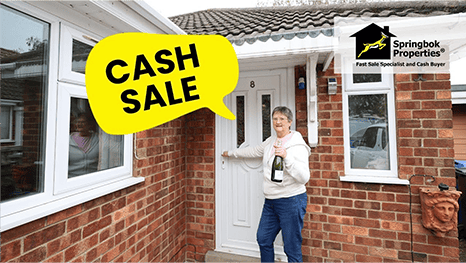
Springbok Properties is one of the UK’s most trusted cash home-buying companies, offering three proven ways to sell, that help sellers sell faster than estate agents and get fairer prices than traditional cash buyers - all backed by award-winning customer service.
Springbok Properties is one of the UK’s most trusted cash home-buying companies, offering three proven ways to sell, that help sellers sell faster than estate agents and get fairer prices than traditional cash buyers - all backed by award-winning customer service.
"We buy any house" companies buy your property directly for cash — any condition, any location — completing in as little as 7 days. A genuine buyer pays around 75–85% of market value, charges no fees, and is registered with the NAPB and The Property Ombudsman. The catch: this is the corner of the market where scams live, so knowing how to spot a real buyer matters more than anything.
The phrase "we buy any house" is used by hundreds of UK firms — some excellent, some brokers who never buy at all, and a few outright scams. This is the complete, honest guide: what these companies are, how they really work, how much they pay and why, the exact tricks to watch for, how to verify a genuine buyer, and how the alternatives compare.
Key takeaways
A genuine "we buy any house" company uses its own funds to buy directly, with no chain and no fees — completing in 7–28 days.
Expect around 75–85% of market value. Anyone promising 90%+ on a straight cash purchase almost certainly isn't genuine.
The sector is largely unregulated: the NAPB and The Property Ombudsman are voluntary schemes, not statutory regulators — so verification is on you.
The most common scam is the last-minute price drop; others include mis-sold "option agreements", lead-generators who only sell your data, and fake reviews.
Before you accept, check proof of funds, NAPB/TPO membership and Companies House, get everything in writing, and use your own solicitor.
Springbok is a genuine, NAPB-registered cash buyer — and if you want closer to full value, our Fixed Price™ route can achieve up to 95% with zero fees.
7 daysfastest completion
75–85%typical genuine cash offer
£0fees — all costs covered
19,000+homeowners helped since 2012
What does "we buy any house" mean?
"We buy any house" is the advertising promise of a property-buying company: it will purchase your home directly for cash, whatever its condition or location, and complete quickly. Because there's no mortgage lender and no onward purchase, a genuine buyer can move in days rather than months. You'll see the same idea marketed as a "cash house buyer", a "quick house sale company" or a "property buying company" — they mean the same thing.
The trade-off is price. In return for speed, certainty and paying your costs, these companies buy below open-market value. Used well, it's the fastest, most reliable way to sell in the UK. Used carelessly, it's where the industry's worst practices live — which is why most of this guide is about telling a genuine buyer from the rest.
How do "we buy any house" companies work?
A genuine company follows a simple five-step process, and does the heavy lifting for you:
You get in touch with your postcode and a few details, and receive an initial cash offer — often within 24 hours.
They value the property using sold-price data and, for a reputable buyer, an independent RICS survey.
You receive a formal offer. With a genuine buyer, this shouldn't drop later unless something material is found.
Solicitors are instructed (a reputable buyer pays the legal costs) and contracts are exchanged.
Completion happens on your chosen date and the funds are transferred to your account.
The "two routes" trap. Some firms advertise "we buy any house" but actually run two very different offers: a direct instant purchase at a low price, or a referral to their database of investors at a higher price that can take months (sometimes up to five). If a company's better price depends on finding a third-party buyer, that isn't a guaranteed cash sale — it's brokerage. Ask which one you're being offered.
How much do "we buy any house" companies pay?
A genuine cash buyer pays around 75–85% of market value. On a £250,000 home, that's roughly £190,000–£212,500 — with no fees and completion in weeks. The discount is the price of speed and certainty, not a trick.
Why do they pay below market value?
The margin covers the buyer's risk and costs: they pay your legal and survey fees, tie up their own capital, pay a higher rate of Stamp Duty as a company/additional-property buyer, and carry the risk of reselling — often within about 90 days — in a market that can move. Reputable buyers make a relatively small margin per property.
How is the offer calculated?
Comparable sold prices from HM Land Registry and automated valuation data such as Hometrack.
An independent valuation — often to RICS "Red Book" standards.
The property's condition and any legal issues — an unmortgageable or run-down home costs more to resell, which is reflected in the figure.
Be wary of any straight cash offer above ~90%. An unusually high figure is a classic bait tactic: it's quietly cut just before completion, when you're committed and under pressure. If you need closer to full value, use a marketed route (see Springbok's Fixed Price™ below), not a too-good-to-be-true cash promise.
Are "we buy any house" companies legit — or a scam?
Genuine "we buy any house" companies are entirely legitimate and have helped hundreds of thousands of UK homeowners. But the industry is largely unregulated — the Office of Fair Trading's 2013 study of the sector exposed under-valuations and last-minute price drops, which is why the NAPB and The Property Ombudsman introduced voluntary standards. Crucially, neither is a statutory regulator with the power to fine, so the responsibility to check falls on you. The good news: the checks are simple, and the rest of this guide walks through them.
What are the most common "we buy any house" scams?
Almost every problem in this industry is a version of one of these tactics. Learn them and you'll spot a bad actor quickly:
The last-minute price drop. The most common complaint by far: an inflated offer is slashed days before completion (real cases have gone from £375,000 to £240,000). Offers aren't legally binding until exchange, which is exactly why some firms exploit it.
Mis-sold "option agreements". You're told it's a cash purchase, but you actually sign an option or lock-in contract that lets the company market your home for commission — and walk away if no buyer appears.
Land Registry restrictions (RX1). A firm asks to place a restriction against your title before completion — a serious red flag if done without your full, informed consent.
Lead-generation firms. They don't buy at all — they capture your details and sell them to third parties.
Hidden and upfront fees. Charges that only surface on completion day, or requests for "valuation" or "cancellation" fees up front.
Fake or manipulated reviews. Only-5-star profiles, no recent reviews, or a flood of reviews in a short window.
Untraceable directors. No company registration number, PO-box-only address, or a hidden legal entity.
Too-good-to-be-true offers and high pressure. Promises of 100% of market value, 24-hour completion, or pressure to sign before you've read the contract.
How do you check a "we buy any house" company is genuine?
Run these checks before you accept any offer — a real buyer will pass all of them without fuss:
Proof of funds. A genuine cash buyer will evidence the money to complete (a bank statement or solicitor's letter). No proof, no deal.
Companies House. Check the firm on Companies House — trading history, filed accounts and named directors.
A guarantee-backed offer in writing. Get written confirmation the price won't change, ideally with compensation if it does.
Never sign an option or lock-in agreement. The only contract you should sign is your solicitor's contract of sale.
Your own independent solicitor. Use your own conveyancer, and ask to see the survey if the offer is ever reduced.
Independent reviews across platforms. Read Trustpilot, Google and allAgents — including the negative ones — not just a curated wall.
Get three quotes and a benchmark. Compare offers from at least three companies, and three local estate-agent valuations, so you know the real market value.
What questions should you ask a "we buy any house" company?
Are you the direct buyer, or will you market my home to someone else?
Can you show proof of funds right now?
Are you members of the NAPB and The Property Ombudsman?
Is your offer fixed and guaranteed in writing — and what could change it?
Who pays the legal and survey costs?
Can I withdraw at any point with no penalty?
Genuine cash buyer vs broker, iBuyer, estate agent and auction
"We buy any house" covers several very different operators and routes. Knowing which you're dealing with tells you how genuine, fast and safe the sale will be.
Type / route
What it is
Price
Speed & certainty
Genuine cash-buying company
Buys directly with its own funds
~75–85%
Fast (7–28 days), very high certainty
Broker / lead-generator
Doesn't buy — passes or sells your details, or brokers via an option agreement
Varies / none
Slow, uncertain — a red flag
iBuyer
Tech firm making instant algorithm offers (rare in the UK)
Near market value, minus a fee
Weeks; strict property criteria
Estate agent
Marketed sale on the open market
90–100%
~5–9 months; ~1 in 4 fall through
Auction
Sale under the hammer (incl. 56-day modern method)
75–90%+
~6–12 weeks; no guarantee it sells
The honest rule holds across all of them: you can sell fast or for top price — rarely both at once.
Real sellers — what they did when another cash buyer dropped its offer by £30k.
The "we buy any house" company landscape
Dozens of firms advertise the phrase, and the names are confusingly similar — which is itself a risk, as scammers imitate established brands. A few of the better-known genuine operators include We Buy Any Home, We Buy Any House, Property Solvers, Quick Move Now, National Homebuyers and The Property Buying Company. They differ in important ways: some are NAPB members and some are not; some buy purely with their own funds while others also run investor-referral or assisted-sale routes. Always check membership and proof of funds for the specific company you're talking to, and don't assume a familiar-sounding name is the firm you think it is — verify the exact legal entity on Companies House. Our guide to the best companies that buy houses compares how their offers differ.
When should you use a "we buy any house" company?
A fast cash sale makes most sense when certainty and speed are worth more than the last few percent of price. Common situations include:
Facing repossession
Complete before a court deadline and protect your equity. More →
Inherited / probate
Release equity and stop the empty-home running costs. More →
Divorce or separation
A clean, discreet split on a settlement timeline. More →
Broken chain
Rescue an onward purchase when your buyer pulls out.
Relocation / emigration
Sell a UK home to a fixed deadline, remotely.
Problem property
Structural issues, short lease or unmortgageable — sold as-is.
What are the pros and cons?
An honest summary of both sides:
Pros
Speed — completion in as little as 7 days.
Certainty — a genuine buyer's funds are ready, so no chain and effectively no fall-through.
No fees — no commission, and legal and survey costs covered.
Any condition — bought as-is, no repairs.
Discretion — no viewings, boards or open-market exposure.
Cons
You accept below market value — typically 15–25% less.
The sector is poorly regulated, so due diligence is on you.
Scams exist — the tactics above are real.
It's not right if maximising price matters more than speed or certainty.
What are the alternatives to a "we buy any house" company?
A fast cash sale isn't the only option — weigh it against these:
Sell on the open market with a high-street or online estate agent for the highest price, if you can wait. See our sell house fast guide for ways to speed this up.
Auction — a legally binding sale with defined timescales; good for unusual or run-down homes. See selling at auction.
Part-exchange with a new-build developer for a chain-free move.
Talk to your lender if the driver is affordability — a payment arrangement or term change may help.
Free debt advice from MoneyHelper, StepChange or Citizens Advice if you're in financial difficulty.
Why sell to Springbok?
Springbok Properties Ltd (company no. 09045757, Manchester) is a genuine, direct cash buyer — an NAPB member, regulated by The Property Ombudsman — that has helped more than 19,000 homeowners since 2012, with 11,700+ independent reviews and awards for customer service. Unlike most buyers, we give you a choice of routes rather than one take-it-or-leave-it figure:
A company buying with its own funds, able to complete without a mortgage or onward sale.
Broker / lead-generator
A firm that doesn't buy your home but passes or sells your details, or brokers a sale for commission.
iBuyer
A technology-led company making instant, algorithm-based offers near market value for a fee; uncommon in the UK.
Proof of funds
Evidence a buyer holds the money to complete — the single most important check on any cash buyer.
Option agreement
A contract giving a company the right to market or buy your home later, sometimes mis-sold as a cash offer.
RX1 restriction
A Land Registry form used to place a restriction against a property's title; a red flag if requested before completion.
Gazundering
When a buyer lowers their offer just before exchange, when the seller is most exposed.
Assisted sale
A route where a company markets your home rather than buying it outright — slower, and not a guaranteed sale.
Exchange of contracts
The point at which a sale becomes legally binding; before it, either side can walk away.
The Property Ombudsman (TPO)
A voluntary redress scheme reputable buyers join; it can require compensation but cannot regulate or fine.
Common Questions — Straight Answers
Springbok Properties™ — Leadership & Team FAQs
Genuine ones are entirely legitimate, but the sector is largely unregulated, so you must check. Only deal with a company that is an NAPB member, registered with The Property Ombudsman, listed at Companies House, can show proof of funds, and fixes its offer in writing.
Around 75–85% of market value for a genuine, fee-free, chain-free sale. Be wary of any straight cash offer above roughly 90% — it usually isn't real, and is often cut just before completion.
A genuine cash buyer can complete in as little as 7 days, though most sellers choose two to four weeks. If a company takes longer than about 28 days, or its better price depends on finding an investor, it may not be a true cash buyer.
A reputable company charges no fees and covers your legal and survey costs. The below-market offer is effectively the cost of the service. Any firm asking for upfront or "valuation" fees is a red flag.
A reputable buyer won't. Last-minute price drops are the most common complaint and a known scam tactic flagged by the Office of Fair Trading in 2013. Get the offer guaranteed in writing, and confirm you can withdraw penalty-free. Springbok's offer doesn't change between agreement and completion.
Yes. Genuine cash buyers purchase homes in any condition — including structural issues, damp, short leases and unmortgageable properties — with no repairs required. Condition is not a barrier to a fast sale.
No — the industry has no statutory regulator. The NAPB and The Property Ombudsman provide voluntary self-regulation and redress, so be suspicious of any firm claiming to be "government regulated". Membership of those bodies is still the best trust signal available.
Yes, always use your own independent solicitor or conveyancer, even if the company covers the cost. Your solicitor confirms the funds and protects your interests, and the only contract you should sign is their contract of sale.
Watch for upfront fees, offers that drop late, pressure to sign an option agreement, requests to restrict your title before completion, no proof of funds, no NAPB/TPO membership, and reviews you can't verify. Get everything in writing and take your time.
A genuine cash buyer purchases your home with its own funds. A broker or lead-generator doesn't buy at all — it passes your details on, or markets your home for commission via an option agreement. Ask directly, and insist on proof of funds.
We value your privacy
We use cookies to enhance your browsing experience, serve personalised ads or content, and analyse our traffic.
By clicking "Accept All", you consent to our use of cookies.
Cookie Policy

 Freephone 24/7 Call: 0800 068 4015